
Background and History
The Kenya Police Service is established by the Constitution of Kenya under Article 243 (1) and (2) (a) as one of the Services constituting the National Police Service. The constitution, administration, powers and functions of the Kenya Police Service are stipulated in part III of the National Police Service Act, No. 11a of 2011.
History of the Kenya Police Service
The Kenya Police has its small beginnings in the period between 1887 – 1902, tracing its foundation on the Imperial British East Africa (I.B.E.A.) Company, and a businessman Sir William McKinnon, who in the interest of his business found it necessary to provide some form of protection (security) for his stores along the coastline of Kenya. It is from this origin that the concept of constituting a real police service was formed in Mombasa. Generally, police activities centered on protection of the business of the I.B.E.A. Company where the strength was mainly of Indian origin with a skeleton staff of some Africans otherwise referred to as ‘Askaris”. During those early stages of the small police force, its duties were negligible.
The construction of the Kenya - Uganda Railway provided for the growth of this infant force inland from our coastline, and by 1902 there existed police service units at Mombasa, Nairobi and Kisumu for the purpose of safeguarding the railways property and materials as well as the manpower engaged in constructing the railway. In essence, peace, law and order had to be maintained despite the fact that the personnel employed then had little training. The laws in force were from India including the Indian Criminal Procedure Code, the Indian Evidence Act and Police Ordinance.
It is notable that up to 1907, the Kenya Police was organized along military lines and the training was military in nature. In 1906, the Kenya Police was legally constituted by a Police Ordinance. In 1926, the Criminal Intelligence Unit was established with the sole responsibility of collecting, tabulating and recording the history and data of criminals, undesirable and suspicious persons.
Special sections like fingerprint bureau and C.I.D. were created starting with a skeleton staff composed of former police officers from Britain and South Africa. This was the foundation of today’s Kenya Police Force.
In the same year, the Railway Police Unit was also established to deal specifically with prevention and detection of offences in the railways from the coast to Kisumu, including Kilindini Harbour and branch lines.
As the years progressed, the scope of police activities increased and it was called upon to deal with traffic problems such as accidents and parking. The police were also called upon to deal with cattle rustling in the countryside.
As a preparation for the Second World War, police recruits were deployed in Northern Frontier Districts to counter the threat from Italian Somali Land and Ethiopia. In addition to fighting alongside regular soldiers, the Kenya Police acted as guides, interpreters and carried out reconnaissance missions in the enemies’ territories.
In 1946, the Police service was placed under the office of the Attorney General. The police officers’ powers were increased, and to cope with the new development, a new Police Training Depot was opened in Maseno.
In 1948, several important developments were made in the Force. The Kenya Police Reserve was formed as an auxiliary of the Force. This Unit used armored cars and was deployed in trouble spots. To improve the effectiveness of crime control, a dog section was also introduced in 1948 and the General Service Unit established and deployed in troubled areas in emergency situations.
In 1949, the Police Air wing was formed to carry out duties as communication and evacuation of sick persons to hospitals and was made part of the permanent Police service in January 1953.
After the declaration of the state of emergency in 1952, there was an immediate increase in personnel to cope with the situation and in response to the Mau Mau insurgency. In 1953, a commission was formed to review the organization, administration and expansion of the Force.
In 1957, the Police Headquarters building was opened and in 1958 the Force was integrated within the Ministry of Defense. In the period prior to independence, the Kenya Police was greatly involved in the maintenance of law and order during political meetings and at the height of the independence election period.
After Kenya gained her independence from Britain on 12th December 1963, there was a need to make some drastic changes in the Administration of the Force. This led to the replacement of the expatriate officers in the senior ranks by Africans. Since then, the Force has realized tremendous achievements in various fields of operation.
Among them, due to the increase in criminal activities and in line with the Police resolve to effectively deal with security threats and to bring down crime to minimal levels, various specialized units have been formed. They include the Anti-Stock Theft Unit, Anti-Motor Vehicle Theft Unit, Tourism Police Unit, The Anti-Corruption Police Unit, Presidential Escort Unit, and the Anti-Terrorism Police.
The 2010 Constitution of Kenya, currently in force, replaced the 1969 constitution, that itself had replaced the 1963 independence constitution. The constitution was presented to the Attorney General of Kenya on 7th April 2010, officially published on 6 May 2010, and was subjected to a referendum on 4 August 2010. The new Constitution was approved by 67% of Kenyan voters and promulgated on 27th August 2010.

The promulgation of the 2010 Constitution of Kenya marked a pivotal moment for the country's police, initiating a comprehensive reform process aimed at transforming the force from a colonial-era instrument of state control into a public service accountable to the people.
This shift from a "Force" to a "Service" was intended to move towards a citizen-centric approach to policing, contrasting with the control and repression associated with the colonial era.
The Constitution, under Article 243, established the NPS, dissolving the previous Kenya Police Force and Administration Police Force. The term was deliberately changed from "Force" to "Service" to reflect a new, citizen-centric policing philosophy.
The previous position of Commissioner of Police, appointed by the President, was replaced with the Inspector-General (IG) who has independent command of the NPS, with the appointment requiring parliamentary approval. The NPS is structured into the Kenya Police Service (KPS), the Administration Police Service (APS), and the Directorate of Criminal Investigations (DCI), each headed by a Deputy Inspector-General or Director.
Colonial Commisioners
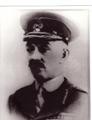
Brig. Gen. F.S. Edward
CBC, MG, DSO, OBE
1908 - 1922
1908 - 1922
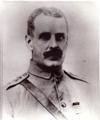
F.D. Thysen
1922 - 1925
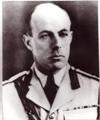
R.C. Cavendish
1931 - 1941
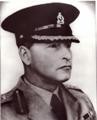
A.J. Kingsley Heath
1941 - 1943
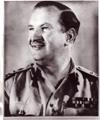
Mr. W.M.G. Sandwith
OB
1943 - 1947
1943 - 1947
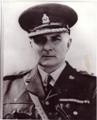
C.H. Ward
OBE
1947 - 1949
1947 - 1949
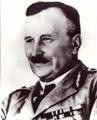
Mr. M.S. O'Rorke
OBE
1950 - 1951
1950 - 1951
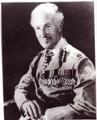
Mr. D.D.M. Mc'Goun
CBE, MBE
1951 - 1954
1951 - 1954
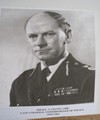
Sir R.C. Cutling
OBE
1955 - 1964
1955 - 1964
Post Colonial Commisioners
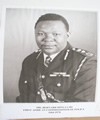
Bernard Hinga
OBS, OCSA
1964 - 1978
1964 - 1978
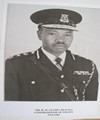
Ben Gethi
CBS, OST, J
1978 - 1982
1978 - 1982
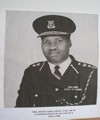
Bernard Njinu
CBS, DCO
1982 - 1988
1982 - 1988
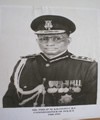
Philip Kilonzo
1988 - 1993
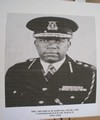
Shadrack Kiruki
MGH, CB
1993 - 1996
1993 - 1996
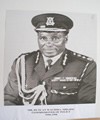
Duncan Wachira
MBS, HSC
1996 - 1998
1996 - 1998
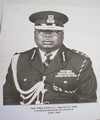
Philemon Abongo
1998 - 2002
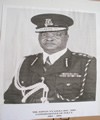
Ediwn Nyaseda
2002 - 2003
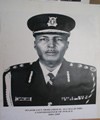
Major General Mohammed H. ALi
MGH, MBS
2004 - 2009
2004 - 2009

Mathew K. Iteere
MGH, CBS
2009 - 2012
2009 - 2012
Deputy Inspector Generals

Grace S. Kaindi
MBS, NDC(K)
2013 - 2015
2013 - 2015

Edward N. Mbugua
MBS, OGW, NDC(K)
2018 - 2024
2018 - 2024
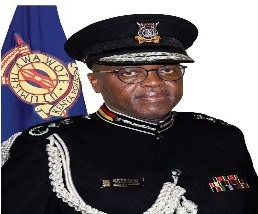
Eliud K. Lagat
CBC, OGW, HSC, SS, NDC
2024 - Date
2024 - Date
Inspector Generals

David Mwole Kimaiyo
2012 - 2015

Joseph Kipchirchir Boinett
2015 - 2018

Hillary Nzioki Mutyambai
2019 - 2022
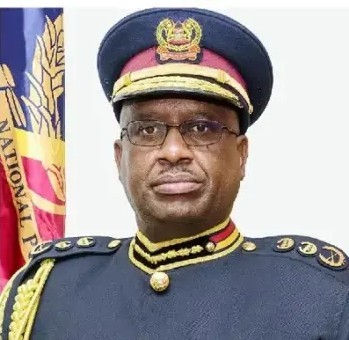
Japeth Koome Nchebere
2022 - 2024
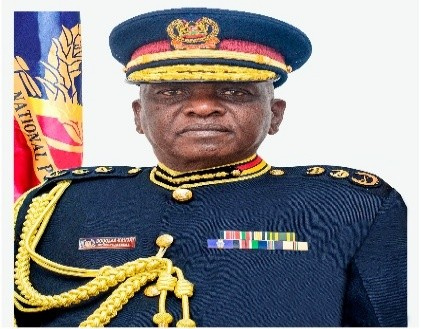
Douglas Kanja Kirocho
MGH, CBS, OGW
2023 to date
2023 to date